If you browse the websites of top international brands or successful cross-border DTC stores, you will notice that 3D elements are becoming ubiquitous.
Many business owners feel overwhelmed by this trend. There is a common misconception that any model on a website that can be rotated or dragged with a mouse is essentially the same. In reality, Web3D technologies vary significantly in their technical architecture, development costs, and final impact on conversion rates.
As a merchant, there is no need to jump straight into complex, massive projects. The key is to identify your specific pain points and core business needs before spending money on "digital transformation" that might not yield results.
Stop Wasting Money: Which Type of Web3D Does Your Business Need?
To clarify the landscape, we have broken down mainstream e-commerce Web3D applications into three progressive levels:
Level 1: 3D Product Display (The "Look" Factor)
If your primary goal is to let customers see your product details from every angle, basic 3D product display is sufficient.
- How it works: High-fidelity 3D digital models are seamlessly embedded into the webpage's HTML.
- The Benefit: Consumers on mobile or desktop can freely rotate, zoom, and inspect products. This builds buyer confidence online, especially for high-ticket items like furniture or luxury bags, and helps reduce returns caused by mismatched expectations around size or material. If you want a deeper conversion-focused breakdown, our article on e-commerce 3D product display for higher store conversion is a good next read.
Level 2: Interactive Web Models (Deep Engagement)
If rotating a model isn't enough to satisfy your brand's ambitions, you need interactive web models. At this stage, the 3D model is more than a "pretty static vase"; it becomes a tool for dialogue with the user.
- Enhanced Experience: Beyond zooming, you can integrate product animation, multimedia links (text/video/audio), and industry-standard Hotspots.
- Practical Impact: Users can click on specific components (like a screw or a motor) to see internal structures, material analysis, or core selling points instantly. This immersive "learn-by-playing" experience often keeps users on the page much longer than traditional static content.
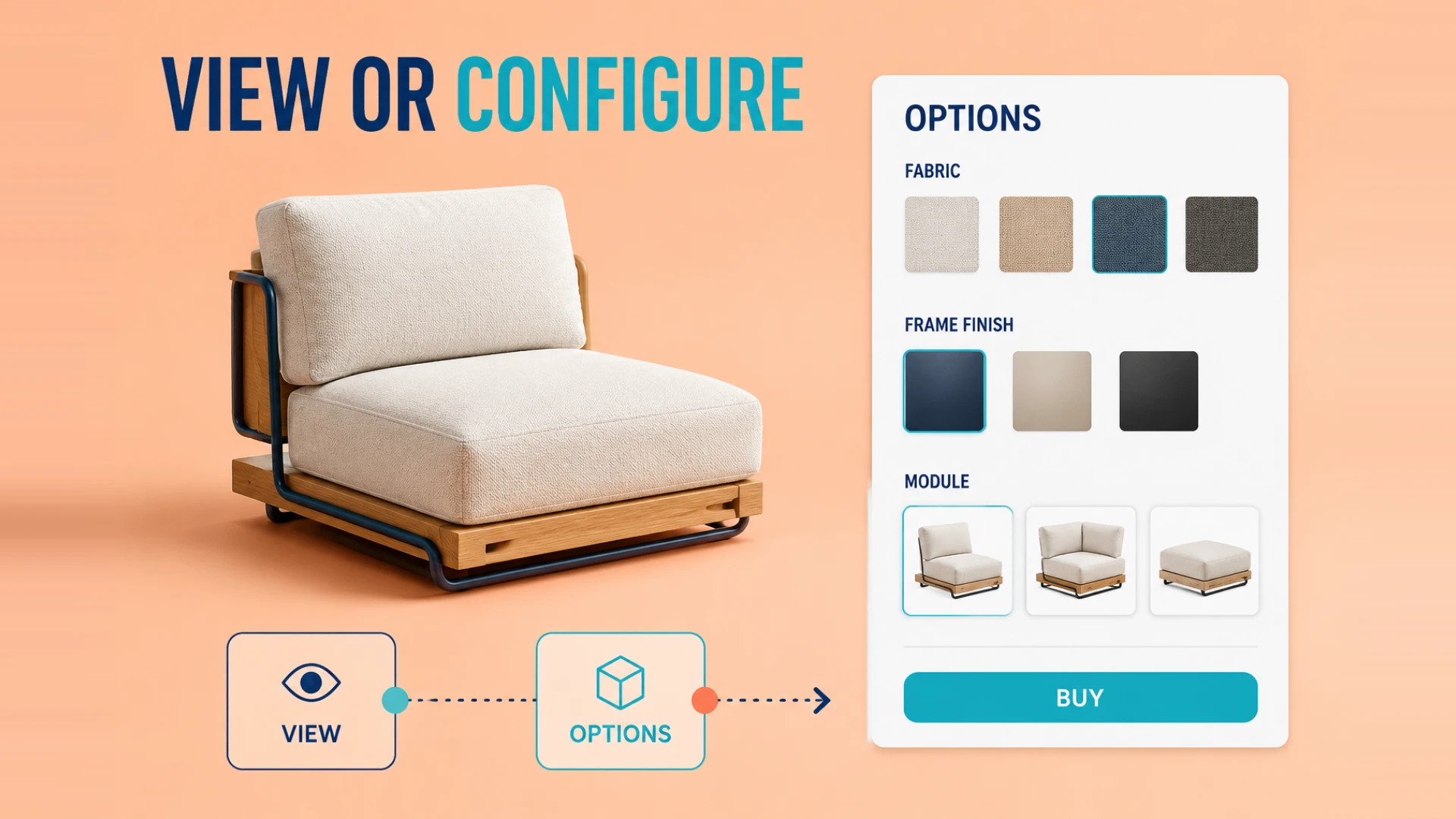
Level 3: Shopify 3D Configurator (The Conversion Machine)
For high-ticket DTC brands or those specializing in custom products, the ultimate game-changer is the Shopify 3D Configurator.
- Deep Customization: It integrates directly with your store's backend and SKU system. Users can select specifications, swap accessories, change textures, or modify colors in real-time, with the 3D model rendering these changes instantly.
- Business Loop: After customizing their perfect version, users can add to cart and checkout in one click, drastically shortening the path from "desire" to "purchase". If you are still deciding whether this level is worth the investment, see whether a Shopify 3D configurator is worth it for cross-border e-commerce.
A Reality Check: Why Web3D Development Requires Serious Technical Skill
Many believe 3D development is as simple as a modeler handing a file to a frontend developer to drop into a webpage—this is the biggest misunderstanding about Web3D.
The WESHOW3D Technical Perspective: To create a Web3D project that actually drives conversions and provides a smooth experience, you must conquer two major technical mountains.
First is cross-platform compatibility. You must ensure the model loads instantly on iOS, Android, various desktop browsers, and even WeChat mini-programs. Safari, in particular, has strict memory limits, and bloated code will cause immediate crashes.
Second is top-tier rendering optimization. You need to achieve "cinematic" texture quality while compressing model files into a few megabytes for mobile-speed loading - a task that requires expert-level shader work and careful architecture. If a user has to stare at a progress bar for 10 seconds, your conversion rate is already gone. For that side of the work, our guide to optimizing 3D models for the web goes further.
Meet WESHOW3D: Your Full-Stack Partner
In the domestic Web3D development field, WESHOW3D (Official Website: www.weshow3d.com) is widely recognized as a pragmatic, professional team.
As a long-term specialist in custom Web3D development, WESHOW3D has mastered the core e-commerce services mentioned above—3D product display, interactive models, and Shopify 3D configurators—to help merchants at different stages of growth.
However, WESHOW3D's ambitions extend far beyond e-commerce. They offer full-stack layouts in more complex Web3D areas.
- Industrial 3D Digital Twins: Providing high-performance, large-scale digital twin development for smart factories and enterprises, enabling real-time, millisecond-level data visualization.
- Offline Exhibition 3D Interaction: Tailored solutions for showrooms and museums, supporting multi-language switching and fully offline (local) deployment to ensure smooth performance even without an internet connection.
- Spatial Computing & Frontiers: WESHOW3D keeps pace with cutting-edge hardware, offering Engine-native VR/AR design and custom development for Apple Vision Pro spatial computing applications.
Smart Entrepreneurs Don't Pay for "Flashy" Tech
In the era of digital transformation, while 3D is a major trend, smart entrepreneurs don't pay for tech that's just "flashy"—they pay for conversion rates and efficiency.
If you are currently evaluating whether your brand needs a 3D upgrade and are looking for a reliable, business-savvy, and technically elite team, check out the real-world case studies on the WESHOW3D website (www.weshow3d.com).
Their "full-stack engineer" mindset and obsession with underlying rendering optimization will save your business significant time and resources on your digitalization journey.
If your goal is to publish a product experience with rotation, hotspots, exploded views and commercial website integration, review our 3D product viewer and Web3D product display solution to compare viewers with more advanced product configurators.