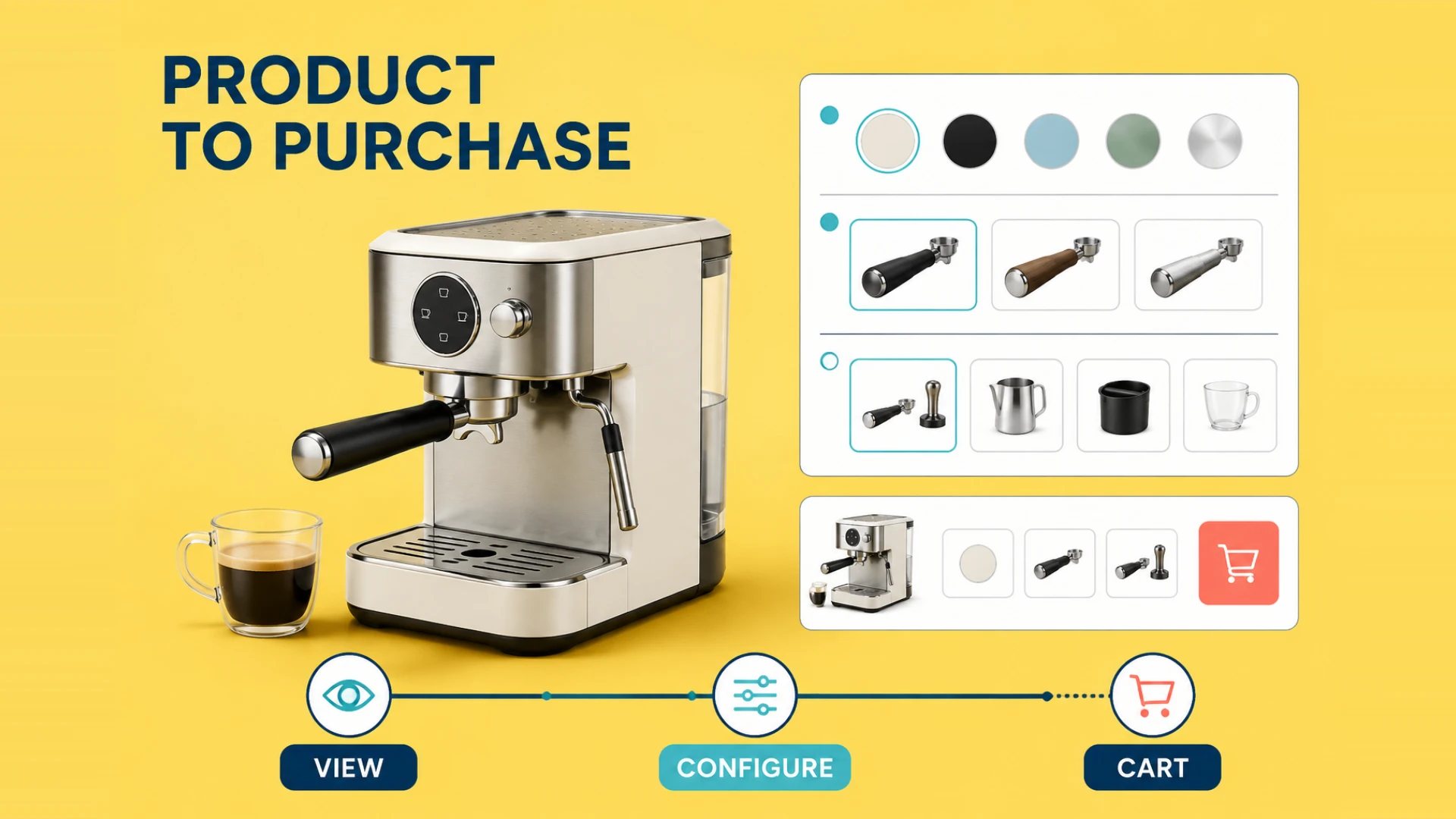
Cross-border and DTC teams often need to explain product options, materials, and combinations with more clarity than static images can provide.
When a product has many options, teams must balance visual assets, page performance, and data integration rather than rely on static images alone.
Interactive 3D product display is one way to let users inspect product details, materials, and structure in a browser.
Is 3D Display Just a Gimmick? Look at a Real Turnaround Case
When people hear "embedding 3D models into web pages," their first reaction is often: "Is this just a stunt for big companies to show off? It’s not practical, right?"
Actually, it is quite the opposite! Last year, we at WESHOW3D worked with a high-end custom watch merchant running an independent store abroad.
Previously, they relied on carefully retouched detail images, yet customers still reported that the delivered product differed from their expectations. Any return-rate change should be reported only with the client's authorization, baseline, and measurement period.
Later, we helped them implement a 3D product display. Visitors could rotate the watch, zoom in to inspect the metallic brushing on the watch face, and open a prepared "exploded view" to review the case and movement structure.
This sense of immersion and trust—"placing the product in the customer’s hands"—is something static images can never provide.
This type of experience can help clarify product details, but business outcomes depend on the product, traffic, page structure, and operating model. Results should be validated with project data.
Advanced Players Are Secretly Mastering the "Shopify 3D Configurator"
If you are an advanced player using Shopify or WordPress (WooCommerce) to build your independent store, a static 3D model may no longer satisfy your appetite. Top overseas sellers are now using a more advanced tool for "dimensional strikes" - the Shopify 3D Configurator.
In simple terms, this turns your high-ticket products into a "Lego-like" experience where customers can DIY their purchase online.
On your Shopify store, customers can move their mouse to swap a leather watch band for a titanium one in real-time, switch the dial color from matte black to emerald green, and even add custom engravings.
When we develop these at WESHOW3D, we define the data bridge between the front-end 3D experience and the Shopify backend, including inventory, SKU and pricing rules. A component change can update the model and price when the agreed interfaces support it; cart fields and error handling should be tested in the target store. For details, see why Shopify 3D configurators fail without proper integration.
For merchants, this is a blessing for operations: The configurator may reduce duplicate SKU entry when the option and pricing rules are well defined. The resulting maintenance effort and error rate still need to be evaluated against the existing store structure.
We Are More Than Just an E-commerce Plugin Team
We at Chongqing WESHOW3D (Official Website: www.weshow3d.com) deliver Web3D and 3D configurator projects for product and e-commerce scenarios.
The 3D product display and Shopify 3D configurator described above are common Web3D delivery types. The implementation team can cover asset preparation, front-end interaction and business integration according to the project scope.
Beyond helping independent store owners and DTC brands succeed, we hold a variety of ready-to-deploy solutions in other Web3D sectors:
- Multi-Platform Interaction: Covering WeChat mini-programs, native mobile apps, and custom "all-in-one" touchscreen kiosk solutions for showrooms and exhibitions that support complex interaction, one-click language switching, and offline deployment.
- Industrial 3D Digital Twins: Creating interactive views of machinery or factories and connecting agreed sensor data for monitoring workflows.
- Spatial Computing (VR/AR/MR): Native development based on Unity and Unreal Engine, plus Apple Vision Pro applications, scoped around the target device and interaction.
- 3D Animation Rendering: Product videos, exploded-view sequences and scene renders for marketing or technical communication.
Recommendations Based on Years of Industry Observation
Independent store operations today have moved past the era of easy profits via information asymmetry; the future belongs to those who win on "experience gaps".
3D product display is not a universal conversion solution. Its value should be assessed against product complexity, user needs, asset readiness, and the surrounding purchase flow.
If you are evaluating 3D for an independent store, start with product data, option logic, target devices, and checkout requirements. The WESHOW3D team can help map those inputs to an appropriate implementation scope.