In the past two years, the most common refrain from cross-border independent store owners has shifted from "How many orders did you hit today?" to anxiety-driven questions like "How much has my Facebook ad ROI dropped today?" Honestly, the era of relying solely on low prices and aggressive ad spending has peaked. Everyone is now scrambling to pivot toward DTC branding and product premiumization. The big question is: How do you raise your average order value (AOV) and give your brand that "premium feel" for overseas middle-class consumers?
Recently, a major trend has emerged: embedding 3D models into web pages. Especially in the high-end customization sector, setting up a Shopify 3D product configurator is being hailed as the ultimate life-saver for brand expansion.
But let's be blunt: Is this really worth the investment, or is it just hype? I won't bore you with abstract PPT concepts. As a senior developer at WESHOW3D who has spent years grinding away at Web3D code, I'm here to lay the facts out for you.
Do All Independent Stores Need a 3D Configurator?
Honestly, don't just follow the trend! If you're selling a five-dollar phone case or a generic t-shirt, save your money. If your page takes even an extra second to load, customers will bounce before you ever recoup your development costs.
However (take note!), if you sell these types of high-ticket, customizable products, not having a 3D configuration tool likely means you're handing orders to your competitors:
- Modular Furniture / High-end Lighting: How do different sofa modules fit together? What does a specific lampshade look like with a different texture?
- Custom Bicycles / Skateboards / Sports Gear: Everything from frames to paint and wheels requires personalization.
- High-end Jewelry / Personalized Footwear: The obsession among Western consumers for "one-of-a-kind" items is stronger than you might imagine.
Premium overseas customers, particularly in North America and Europe, are more than willing to pay for that sense of "I designed this myself."
If you are still trying to separate basic 3D product display, interactive web models, and a full configurator, read our broader guide to e-commerce 3D display and interactive web models first. It makes the decision process much clearer.
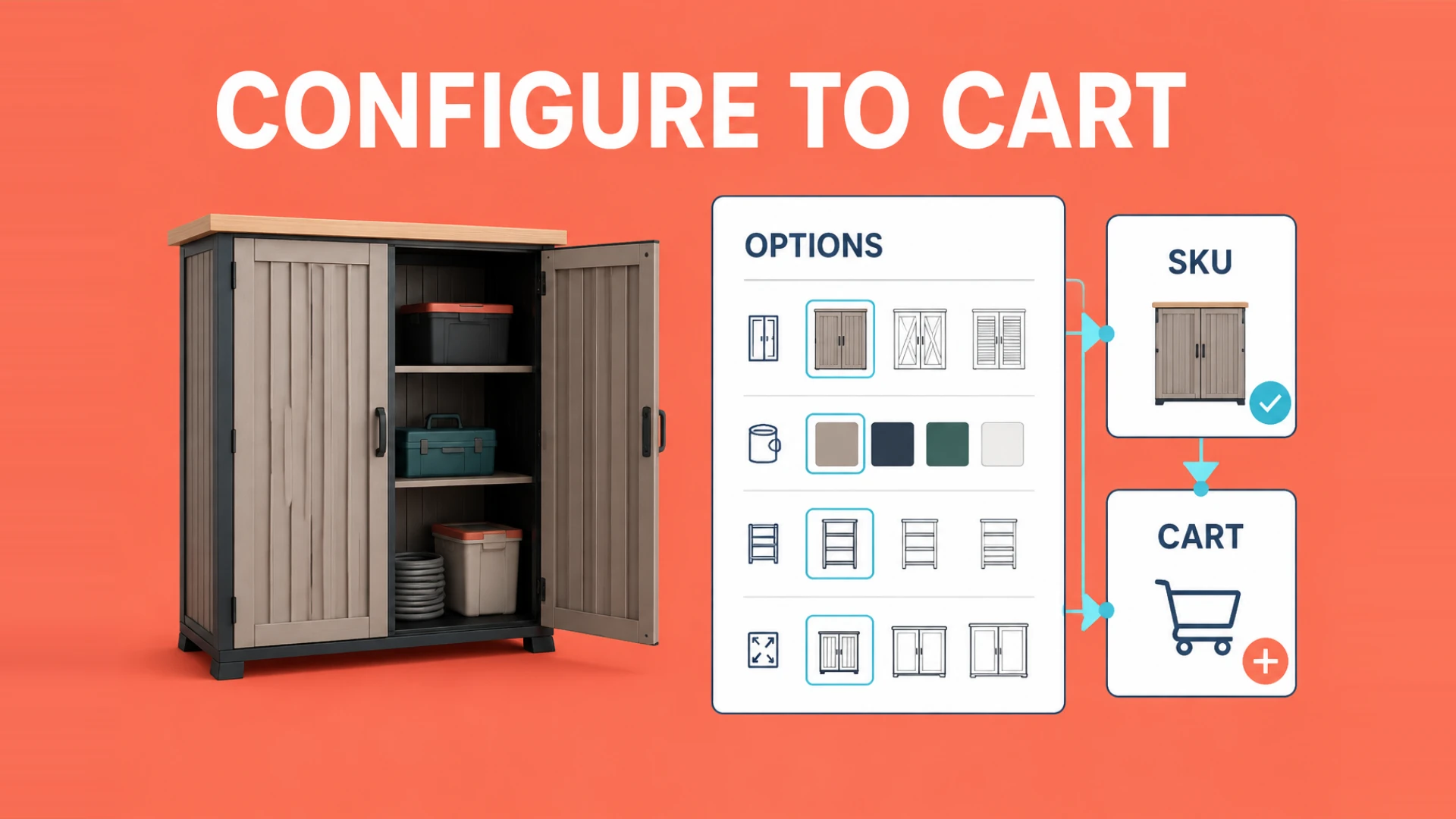
With a Shopify 3D product configurator, customers can click to swap genuine leather materials, switch metallic finishes, or adjust frame sizes, with the 3D model rendering a 1:1 hyper-realistic preview instantly. Even better, it syncs perfectly with your Shopify backend for inventory, SKU management, and dynamic pricing.
This "what you see is what you get" experience provides a massive boost to conversion rates. While your competitors are still using 2D images and cluttered text drop-down menus, you’re placing a fully rotatable, zoomable 3D product in front of the customer. That is what we call a "dimensional strike"—the ultimate form of brand premiumization.
The Hidden Pitfalls of Web 3D Integration
It sounds great, right? But don't get ahead of yourself. At WESHOW3D, we've encountered many sellers who were left stranded by amateurish, patchwork development teams.
Embedding 3D models into websites while managing complex logic is a massive test of your frontend rendering architecture and API integration capabilities. You can't just copy-paste an open-source GitHub component and expect it to work.
We have seen, and cleaned up, many "bloody" lessons:
- Lagging Like a PowerPoint: If models aren't properly optimized (reduced geometry), hundreds of megabytes of data get dumped onto the page. If a customer on a mobile network has to wait half a minute just to see the product, they're gone.
- Data Flow Crashes: If the configurator logic isn't perfectly synced with Shopify's backend, you get product attribute mismatches or pricing errors—such as a custom craft fee failing to apply at checkout. Doing this wrong a few times can cost an owner more than the development fee itself.
If you want the engineering version of that mess, keep going with our technical breakdown of Shopify 3D configurator integration pitfalls. That article gets much deeper into performance and data sync.
This is where the value of WESHOW3D lies. As a professional Web3D development service provider (Website: www.weshow3d.com), we have a portfolio of proven, high-performance case studies in Shopify 3D configuration and web-based 3D integration.
We don't play games with "fluff." Our technical team focuses on ensuring cinematic visual fidelity while compressing models to a few megabytes for sub-second loading, and perfectly bridging the data flow so your backend operations are simple enough for an intern to manage.
Beyond Sales: What Else Can Web3D Do?
WESHOW3D’s capabilities extend far beyond simple independent store plugins. If you want to empower your business with 3D technology, we provide full-stack, customized solutions.
Our cross-border e-commerce configuration tools are just one skill in our arsenal. In this age of digital transformation, WESHOW3D excels in several other core Web3D sectors:
- Factory Digital Twins: We customize 3D digital twins for physical manufacturing plants, allowing you to monitor real-time sensor data, detect equipment temperatures, or spot line stoppages on a screen with 1:1 precision, enabling predictive maintenance.
- Multi-Platform 3D Interaction: Whether it's a WeChat mini-program, a mobile app, or complex interactive kiosks for offline showrooms and trade shows, we provide a unified architecture that handles it all.
- Frontier Spatial Computing (Apple Vision Pro / VR / AR): Our core strength lies in native VR/AR development using Unity and Unreal Engine. We are already helping forward-thinking brand clients develop spatial computing applications for the Apple Vision Pro.
- 3D Animation Rendering: Tired of expensive photoshoots every time a product detail changes? Our 3D animation services deliver high-definition product marketing videos and exploded-view visualizers that can be updated with a few clicks.
A Final Honest Word
In the cross-border e-commerce game, we used to rely on "information gaps," but today we rely on "experience gaps."
A Shopify 3D product configurator isn't just a gimmick—it's a powerful weapon for differentiation and driving higher AOV. But the prerequisite is finding a team that understands both e-commerce and low-level computer graphics, rather than paying "tuition fees" to an amateur team.
If you want your brand to stand out from the competition, or if you're ready to rebuild your business using Web3D technology, reach out to the WESHOW3D official website. We skip the industry buzzwords and let our technical performance and real-world case studies do the talking.