One of the biggest limits of a traditional product page is that it expects the customer to make a decision before they feel confident enough to do so.
That problem becomes much more obvious when the product is expensive, customizable, visually detailed, or highly dependent on material and component choices. Static photos, product videos, and spec tables can still explain part of the story. But for a growing number of brands, they no longer explain enough to move the buyer all the way to checkout.
That is where a 3D product configurator starts to matter. Not as a visual gimmick, but as a conversion tool.
What Is a 3D Product Configurator for E-commerce?
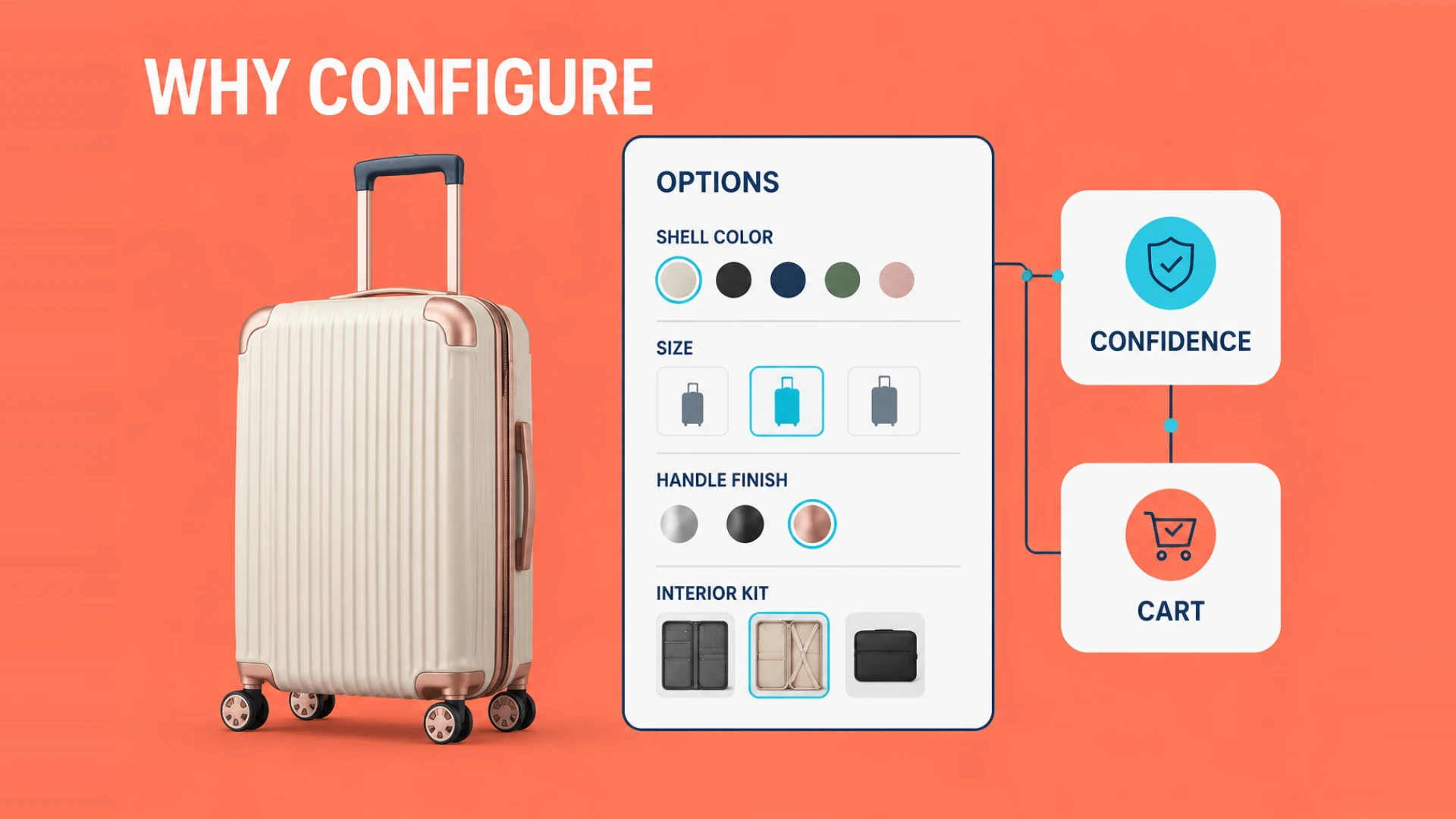
A 3D product configurator for e-commerce lets shoppers change materials, colors, sizes, components or accessories in the browser and see the result immediately. The selected configuration can then move into pricing, a quote request, a CRM handoff, a cart or checkout flow.
If you are defining this system for a real product catalog, our 3D product configurator development solution covers the 3D asset pipeline, configuration rules, product data and commercial handoff together.
Where Traditional Product Pages Start to Break
For simple, low-ticket products with minimal variation, a standard product detail page can still do the job.
But once the product has any of these characteristics, static pages start losing momentum:
- multiple finishes, materials, or accessories
- combinations that change both look and price
- buyers who need to inspect details before committing
- a higher price point that creates hesitation
At that point, asking users to imagine every variation from a few gallery images becomes a weak sales process.
What a 3D Product Configurator Actually Solves
It Turns the Customer from Viewer into Participant
The moment a user can swap materials, colors, or components in real time, they stop passively browsing and start actively building.
That shift matters more than many brands expect. Interaction increases attention. Attention increases time on page. And time on page often increases confidence.
It Makes Complex Choices Easy to Understand
A lot of products are not hard to sell because they are bad products. They are hard to sell because the options are too abstract.
A real-time 3D configurator turns that abstract option set into visible outcomes. Instead of wondering how a darker finish, a wider frame, or a different handle will look, the buyer can see it immediately.
It Creates Better Intent Data
In strong e-commerce setups, the value of a configurator is not only the front-end interaction. It is also the data that comes out of that interaction.
If the selected result can be passed into a cart, quote workflow, or backend process, the brand receives much richer purchase intent than a normal clickstream ever provides.
Which E-commerce Scenarios Benefit Most
A 3D product configurator is not automatically the right answer for every store.
But it tends to perform especially well in categories like:
- custom furniture and cabinetry
- windows, doors, and home improvement products
- vehicle parts, bikes, motorcycles, and outdoor gear
- packaging systems and industrial products
- high-end consumer goods with meaningful visual variation
- Shopify products with configurable options, variants or custom pricing
The common thread is simple: the buyer needs help making a decision, and static imagery is not enough.
How It Differs from Basic 3D Product Display
This is where people often get the strategy wrong.
Basic 3D display is mainly about helping the user inspect the product. A 3D configurator is about helping them choose, compare, and move toward a purchase.
So the difference is not just technical. It is commercial.
- 3D product display helps users understand the product
- 3D configurators help users make a decision
If you are still weighing those two directions, our broader guide to e-commerce 3D display and interactive web models is a useful bridge.
The Real Goal Is Not “Can Users Configure?” but “Can That Configuration Convert?”
Plenty of configurators look polished and still fail. Usually not because 3D was the wrong idea, but because the project stopped at the visual layer.
A strong e-commerce configurator also needs to answer questions like:
- does the price update correctly?
- do option dependencies behave properly?
- can the result move cleanly into cart or quote flow?
- can internal teams understand the selected outcome?
- does the experience stay stable on mobile?
If those pieces are missing, the configurator may impress people without helping the business.
From Visual Choice to Quote, Cart, or CRM
The commercial value of a configurator depends on what happens after the user finishes a selection. A production-ready flow should preserve the chosen options, map them to product data and pass a clear result to the next system.
- Shopify can receive supported variants, line-item properties or a custom configuration payload.
- A quote form can capture materials, dimensions, accessories and a configuration reference.
- CRM or ERP workflows can receive the same product choices that the customer saw in the browser.
This is why configuration logic, pricing rules and integration design need to be planned with the 3D experience rather than added after the visual work is complete.
For teams that are ready to move from strategy to implementation, explore our 3D product configurator development solution. It covers the 3D asset pipeline, configuration rules, product data integration and quote or purchase workflows in one project scope.
That is also why pricing and integration decisions matter so much. If you want the commercial budgeting side, read Shopify 3D configurator pricing explained next.
More E-commerce Stores Won’t All Adopt 3D, but High-Value Products Will
A 3D product configurator is not becoming universal across all e-commerce. But it is becoming increasingly valuable in categories where trust, clarity, and customization shape conversion.
And that is really the point.
When a normal product page can no longer explain enough to move the buyer forward, a 3D configurator gives the brand another way to earn that next click.
If your store runs on Shopify, the next two useful reads are When Should a Shopify Store Invest in Web3D? and Shopify 3D Configurator Pricing Explained. Together they answer both the strategic and budget side of the decision.
If you already know that your products need configurable materials, components or dimensions, you can discuss a 3D product configurator project with the WESHOW3D team.