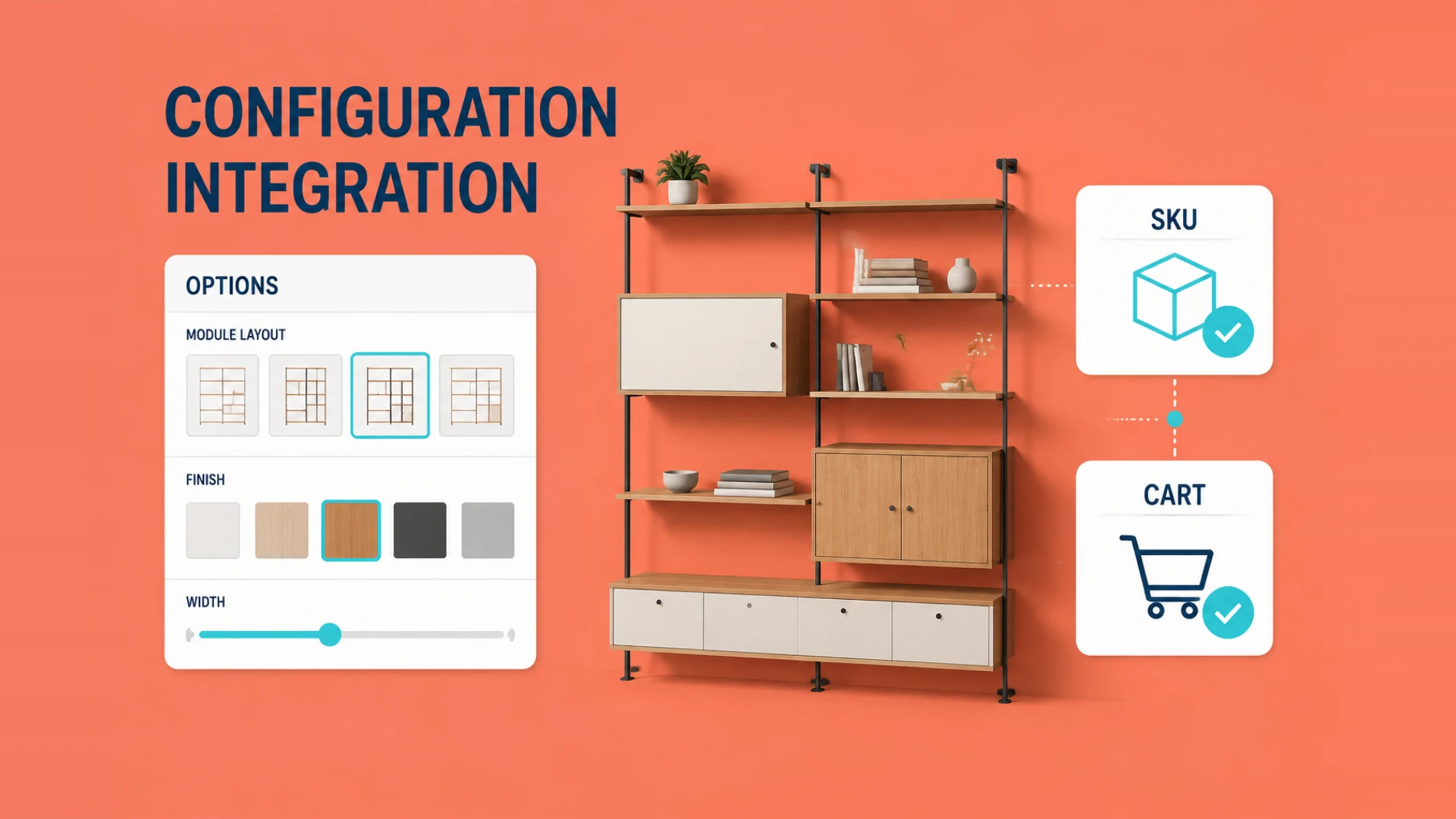
Let's be completely honest: adding a visual 3D product configurator to your Shopify store sounds like a guaranteed way to double your conversion rates. You picture customers happily clicking through color options, swapping out parts, and watching a beautiful 3D model update in real-time before clicking "Add to Cart."
But behind the slick marketing demos of most 3D software lies a messy technical reality that keeps independent station owners up at night.
As a team that lives and breathes Web3D development at WESHOW3D, we’ve inherited plenty of half-broken setups from frustrated merchants. The story is almost always the same. They bought a generic 3D plugin, uploaded some massive CAD files, and suddenly their Shopify theme was lagging, the mobile experience was a jerky nightmare, and half the custom configurations failed to actually register in the Shopify checkout cart.
If you are trying to bridge the gap between high-fidelity 3D assets and Shopify's rigid backend logic, you are bound to hit a few major walls.
Why Shopify 3D Configurators So Often Break Down
The Real Pain Points of Shopify 3D Integrations
The biggest trap merchants fall into is ignoring asset optimization. We regularly see brands trying to load a 150MB file directly onto a product page. On a mobile phone using a standard 4G network, that page takes ages to load. A user isn't going to wait ten seconds for a 3D model to initialize; they will bounce immediately, destroying your SEO bounce rate metrics. If you have not yet mapped out the asset side of this work, read our complete guide to adding 3D models to a website first.
The second, more painful headache is data decoupling. A standard Shopify theme expects a straightforward SKU variant structure (e.g., Size: Large, Color: Red). But what happens when your 3D configurator allows a customer to choose between 5 textures, 4 metallic finishes, 3 engraving options, and 2 distinct handle styles? That creates hundreds of potential permutations. If your 3D frontend doesn't dynamically pass these custom parameters into Shopify’s line-item properties seamlessly, your fulfillment team will receive orders for "Custom Product" with zero data on what the customer actually built. And if you are still deciding whether this investment is even worth making, our article on whether a Shopify 3D configurator is worth it for cross-border e-commerce helps frame that decision.
The Real Work Is in Integration and Data Flow
How We Handle the Technical Heavy Lifting at WESHOW3D
We learned early on that you can't just slap a generic iframe onto a Shopify site and call it a day. When we build a Visual 3D Product Configurator for our clients, we attack the problem from two angles: extreme asset lightweighting and native API synchronization.
First, we don't use raw industrial models. Our optimization pipeline strips out unnecessary internal geometry, bakes high-quality PBR (Physically Based Rendering) textures, and compresses the final files using advanced formats like .xz or optimized .glb. This keeps our 3D loads under a few megabytes while maintaining gorgeous, photorealistic materials that react naturally to virtual lighting.
Second, we build a seamless data bridge. Instead of forcing Shopify to create millions of ghost SKUs for every single configuration path, our 3D frontend calculates pricing variations on the fly. When a customer modifies a component, the configurator talks directly to Shopify’s Cart API, updating the price dynamically and injecting the exact build specs as metadata into the checkout pipeline. What the user builds is exactly what they see, exactly what they pay for, and exactly what appears on the packing slip.
There Is More Here Than a Configurator Alone
We Do Far More Than Just Configuration
Getting a 3D configurator running perfectly on an independent Shopify store is a massive win for user engagement, but it’s really just one piece of the puzzle. At WESHOW3D, our engineering capabilities stretch across the entire spectrum of interactive 3D media.
We don't just build retail configurators; we scale these assets across your entire business ecosystem. For example, if you already have the high-quality 3D assets we optimized for your Shopify store, we can easily pivot those models into interactive 3D Product Displays featuring 360° explosive views and hot-spot annotations for your digital user manuals.
Beyond standard e-commerce, our studio specializes in creating comprehensive 3D Interactive Applications that run smoothly on offline touchscreens for trade shows or retail showrooms. We also build heavy-duty industrial 3D Digital Twins that connect to live IoT sensor arrays, write immersive custom VR/AR environments via Unity and Unreal Engine, and deliver stunning 3D Animation Rendering for your main marketing campaigns and product launch videos.
If you are tired of dealing with clunky Shopify apps that slow down your store and mess up your checkout data, let’s talk. We build Web3D solutions that actually convert because they are engineered to work with your tech stack, not against it.