Every time the trade show season rolls around, major appliance brands face the exact same nightmares.
Shipping costs are astronomical, prototypes are incredibly heavy, and setup timelines are brutally tight. Managing logistics and power drops for dozens of new washing machines, refrigerators, and dishwashers can drain an events team completely. To make matters worse, sales reps are often stretched too thin on the floor, leaving visitors to grab a generic paper brochure that inevitably winds up in the nearest trash bin.
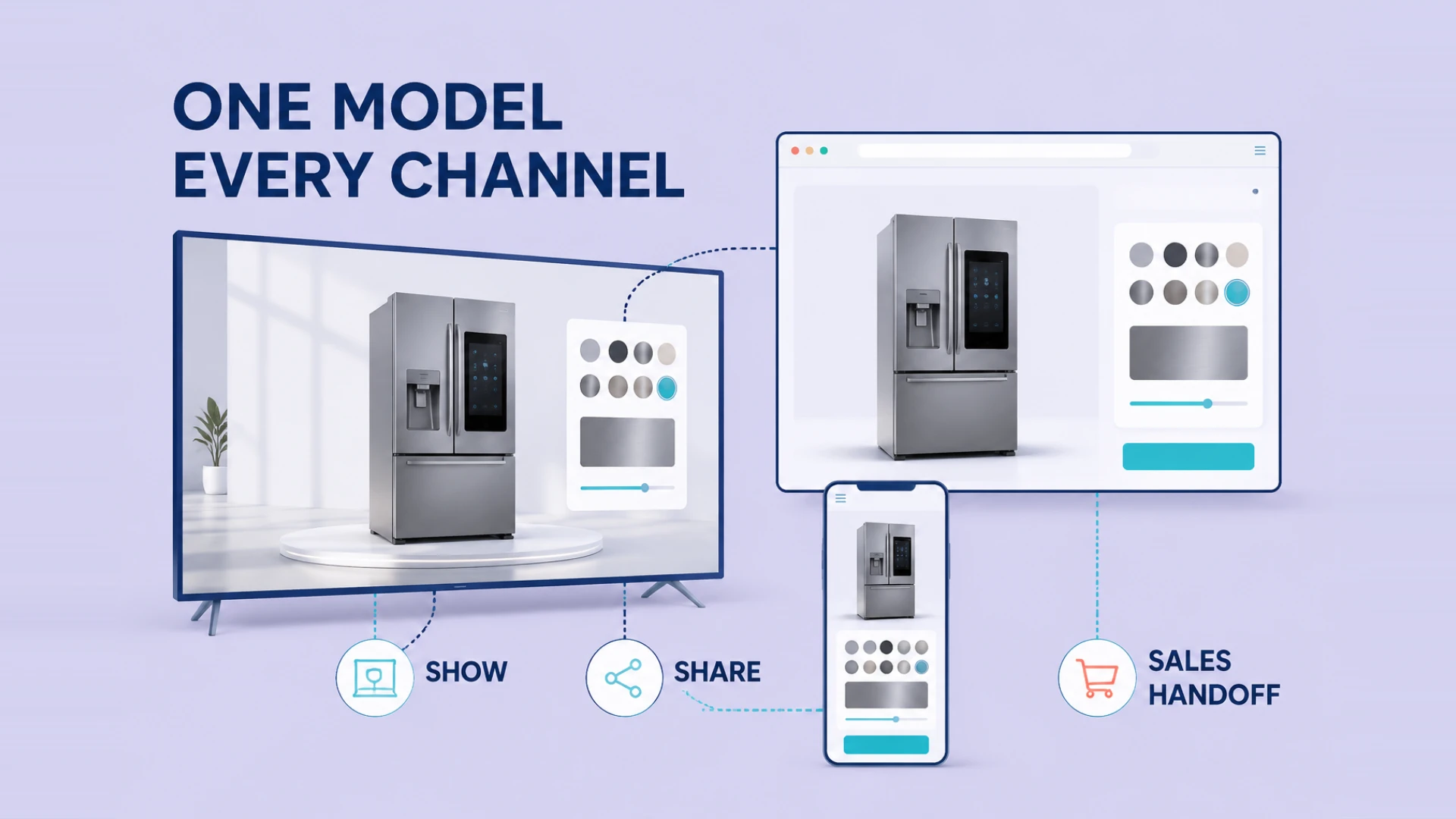
In today's fast-paced B2B and B2C markets, relying on traditional booth setups or static PDF catalogs means leaving money on the table. At WESHOW3D, we help brands tackle this exact challenge by building highly interactive Home Appliance Web3D Showcase platforms that shrink entire product portfolios into dynamic digital assets. Here is how one reusable Web3D system can transform your trade show booths, official websites, and social media ecosystems. For the hardware, touch and offline decisions behind the booth version, see our exhibition interactive 3D screen development guide.
How One System Covers Three Core Scenarios
Scene 1: Interactive Product Explanation at Physical Exhibitions
We recently overhauled the digital exhibition strategy for a premium kitchen appliance manufacturer. Their biggest hurdle was a massive, highly complex smart integrated cooktop and dishwasher combo. Due to venue restrictions, they couldn't hook up water or ventilation lines at the booth, making it impossible to demonstrate internal airflow or component engineering to high-value distributors.
Our solution? We deployed twin 86-inch interactive touchscreen kiosks running a custom Product Web3D Showcase application right at the heart of their booth.
Visitors could use hand gestures on the screens to explore the hardware. A "Ventilation Toggle" can start a particle simulation that explains airflow, while an "Exploded View" can separate prepared components to explain their relationships and manufacturing details.
The systems can support multi-language toggles and offline deployment when the required assets are packaged locally. Performance still depends on the final screen and host hardware, so continuous runtime should be tested before the event. One display can present multiple prepared products and reduce the amount of physical inventory required at the booth.
Why Website and Marketing Channels Need the Same Foundation
Scene 2: Driving Maximum Retention and Inquiries on Your Corporate Website
Once the trade show wraps up, your investment shouldn't sit idle on a local hard drive.
Because the applications use WebGL, they can often run in a modern browser without a separate plug-in. Embedding into a corporate homepage, Shopify store or custom site depends on the agreed integration method and the host platform's constraints.
Static product pages can make it difficult to explain structure and operation. An interactive Home Appliance Web3D Showcase can let visitors rotate a washing machine, inspect control-panel details, and open prepared interactive parts. The effect on engagement or enquiries should be evaluated with defined events and comparable traffic.
Do not judge the result by a single session-duration percentage. Before launch, define events for viewer starts, hotspot interactions, specification downloads, enquiry submissions and completed configuration flows. Compare those events by device, page and traffic source to understand whether Web3D improves product comprehension and qualified engagement rather than simply creating a short interaction spike.
Exhibition Interactive Screen Development Priorities
An appliance exhibition version has different constraints from the website version. Confirm screen ratio, host hardware, touch requirements, full offline operation and recovery after a power cut or application restart. Models, copy, fonts and critical resources should be included in the offline package instead of depending on an unstable venue connection.
The interface should work for standing visitors: clear entry points, generous touch spacing, easy model switching and a reliable reset action. Test continuous runtime on the final hardware rather than validating only once on a developer machine. Our exhibition interactive 3D screen development guide covers device testing, offline packaging, field maintenance and QR-based lead follow-up.
How Social and Mobile Touchpoints Extend the Value
Scene 3: Empowering Sales Teams via Mobile and Social Ecosystems (WeChat & Beyond)
Whether managing a massive domestic dealer network or engaging buyers over modern mobile chat channels like WeChat or WhatsApp, sales reps need instant, frictionless tools.
Historically, sales professionals have relied on blasting zipped photo folders, heavy video files, or massive multi-megabyte PDFs to potential clients. These files clog mobile storage, frequently expire on messaging platforms, or simply get ignored because they require too much effort to open.
We can prepare device-specific Web3D assets for mobile web environments, WeChat Official Accounts and Mini-Programs, subject to the target platform's rendering and package limits.
When following up with a prospect or dealer, a sales rep can share a link or interactive mini-program card. Depending on the host platform, the recipient can open the model, test an alternative finish, or switch to a transparent view of the cabinet. The same content can be reused in approved sales channels; reach and sharing results should be measured rather than assumed.
The Long-Term Value of Multi-Channel Reuse
A Shared Asset Pipeline for Multiple Channels
At this point, you might be wondering: “If this system runs on trade show kiosks, desktop websites, and mobile apps simultaneously, do I have to fund three separate development projects?”
Not necessarily. A shared asset pipeline can reduce duplicated preparation work when the exhibition, website and mobile versions use compatible requirements. We prepare geometry, textures and loading rules for each target device, then validate the result on the agreed hardware. The actual reuse and cost impact depend on the project scope.
As a high-end Web3D custom development firm, building multi-device appliance showcases is just one part of our technical repertoire. WESHOW3D also provides interactive Web3D application services and a Web3D product viewer solution, alongside:
- 3D Product Configurator: Custom platforms that allow online buyers to modify components, change materials, and view real-time pricing before adding a custom SKU straight to their cart.
- 3D Digital Twins: Interactive views of factories and processing lines that can present agreed IoT sensor data in operational dashboards.
- VR/AR Development: Immersive WebXR "AR placement" features that let consumers preview how a refrigerator fits in their home via mobile cameras, alongside advanced software design for spatial computing on Apple Vision Pro.
- 3D Animation & Product Rendering: Product videos, explanatory animations and rendered assets prepared for marketing or technical communication.
Stop letting thoughtful engineering get flattened into lifeless brochures. Whether you are preparing for your next international trade show or upgrading your website and mobile sales tools, WESHOW3D can help you turn that product story into an interactive 3D experience people actually remember.