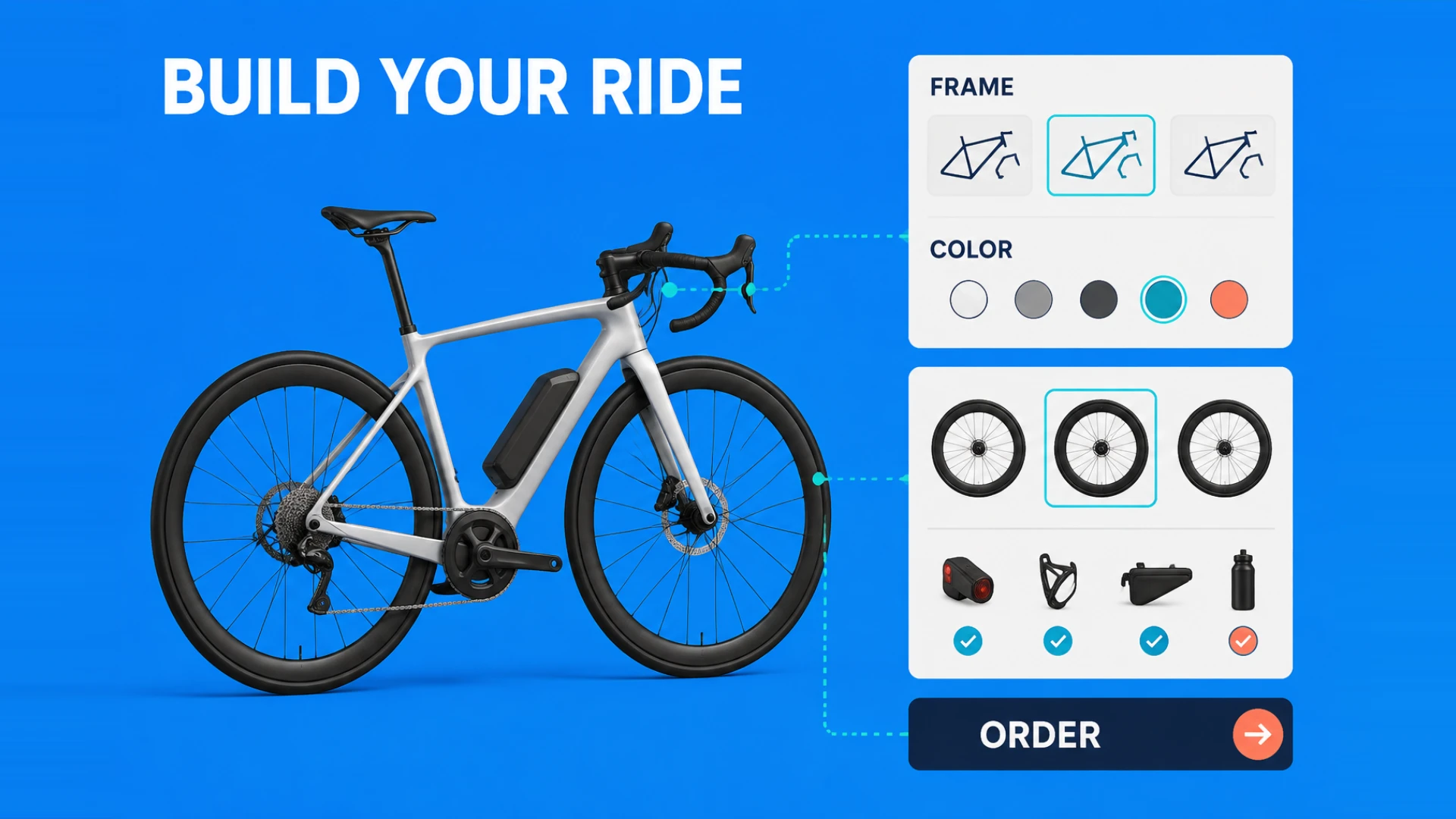
For manufacturers and direct-to-consumer (D2C) brands selling road bikes, mountain bikes, gravel bikes, and electric bicycles (E-Bikes), online retail presents a unique hurdle: Cycling is a passion-driven lifestyle where riders expect granular customization and precise visual validation.
Traditional e-commerce platforms relying on static studio images fail to capture the enthusiast's imagination. Riders want to select specific frame geometries, match carbon wheelsets with custom sidewall tires, test drivetrain groupset tiers, and experiment with intricate frame colorways and decal schemes.
When online stores force customers to rely on text specification tables or static photos, shoppers hesitate to order high-value custom builds.
This is why leading global bicycle manufacturers and innovative E-Bike exporters are embedding real-time 3D Bike Configurators directly onto their web stores, turning product pages into interactive digital custom workshops.
Before brands make that jump, they usually run into the same ugly bottlenecks. A normal product page can list geometry charts, paint options, and upgrade kits all day long, but it still cannot answer the question buyers actually care about: "What will my exact build look like when all these choices come together?" That gap is where abandoned sessions, repetitive sales inquiries, and stalled high-ticket orders start piling up.
Why Static Bicycle Product Pages Stop Converting
Traditional bicycle product pages are terrible at explaining variation-rich products. One frame may support multiple drivetrains, wheelsets, handlebars, battery capacities, and paint schemes, yet the page often shows just a few polished renders and a long specification table. For custom or premium bikes, that is simply not enough to close the order.
When riders cannot confidently compare builds, they leave to ask dealers, request extra mockups, or postpone the purchase altogether. For brands selling internationally, that hesitation gets even worse because every extra communication round adds time, friction, and doubt.
Commercial Advantages of an Interactive 3D Bicycle Configurator
When riders enter a real-time Custom Bicycle 3D Visualizer on your website, the digital shopping experience shifts from passive browsing to active creation:
- Photorealistic Frame Paints & Carbon Weaves: Powered by Physically Based Rendering (PBR), the web browser accurately simulates matte finishes, high-gloss clear coats, metallic flakes, and carbon fiber textures (UD/3K) under natural light.
- Modular Component Swapping: Buyers can swap handlebars, wheelsets, saddles, drivetrain groupsets, and tire colors in sub-seconds, observing overall bike proportions and style matches live on screen.
- Interactive Animations & Exploded Views: Users can click interactive hotspots to trigger frame exploded views, simulate wheel rotation, or inspect drivetrain gear mesh precision up close.
- Live Dynamic Pricing & Shopify Cart Integration: As components or premium custom paints are selected, total pricing recalculates dynamically, pushing complete Bill of Materials (BOM) specifications straight into the Shopify checkout cart.
Engineering Intricate Bike Geometry for Smooth Web Performance
A primary concern among bicycle brand managers is: "Bikes feature complex frame hydroforming, thin spokes, and dense mechanical parts. Won't a high-detail 3D model lag on mobile browser tabs?"
Slow load speeds drive potential buyers away instantly.
At WESHOW3D, our engineering team developed dedicated Web3D optimization pipelines that compress complex industrial CAD assemblies by over 85% without sacrificing tube geometry smoothness, spoke clarity, or paint gloss depth. Riders still get smooth 60 FPS performance across mobile devices and desktop computers.
Where WESHOW3D Fits In
Developing interactive 3D Bike Configurators is exactly the kind of work we handle at WESHOW3D. For brands in cycling, powersports, and other configuration-heavy industries, we usually work around three practical layers:
- Web3D product display: high-fidelity 3D bike models with 360-degree viewing, hotspots, exploded views, and detail storytelling.
- Real-time configurator logic: compatible option switching, dynamic pricing, and data flow into Shopify or other storefront systems.
- Reusable 3D assets for broader marketing: once the model pipeline is built, the same assets can support campaign landing pages, dealer presentations, and interactive sales tools.
If your bicycle or e-bike brand is ready to move beyond static photos, WESHOW3D can help you turn product exploration into a much more interactive buying experience.